Showing posts with label development. Show all posts

Let Them Serve Themselves


Marie at Make and Takes posted last week about ways that she encourages independence in her kids.  I'll admit that I sometimes have to let go of my clean-house-hangups, but I try to give my little ones age-appropriate opportunities to serve themselves rather than continuing to depend on me for, well, everything!  As they've gotten older and had practice with the tasks I provide we've had fewer messes, less spillage, and, honestly, a bit less work for me!  A few of my favorites:
  • I keep a portion of milk in pint-sized plastic bottle that the kids can easily get out of the fridge themselves.  They can pour a cup or add it to cereal without risk of spilling (too much).
  • Our set of condiment cups has come in handy for allowing the kids to serve themselves, well, condiments!  Enough brown sugar or raisins fits perfectly and the children can add it to their oatmeal without contaminating the entire jar.  They're also handy for enough peanut butter to spread on crackers, or ketchup for a few fries. 
  • Daisy loves to help in the kitchen and I give her whatever tasks she can handle.  She uses her little chopper to help cut veggies for stew or fruit for salad, and is great at measuring.  It may not all make it in the bowl, but in another couple of years she'll be well-prepared to cook with just a bit of supervision. 
  • We all have jobs in the house, and each 'older' child is responsible for putting the childrens' dishes away, putting their own dishes in the sink after meals, and bringing their laundry basket to the laundry area.  Oh, and they love to clean the toilet (it's right at their level!). 
How do you encourage your children's independence?  Do you have specific chores that they're required to help with?  (I can always use a bit more help around the house :)
Let Them Serve Themselves SocialTwist Tell-a-Friend

Creative Discipline 102: House Rules

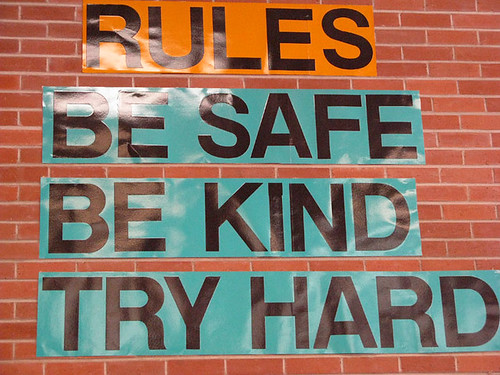
Once I filled my head with all these great disciplinary ideas, I realized that I had to set out a concise set of rules for the kids to follow. I sat down a wrote out a (very long) list of things that I thought were particularly important. Here's a small portion of that list: (image via bolsa bonita)

  • No jumping/climbing on the furniture.
  • No spitting.
  • No calling names.
  • No touching/playing with someone's else's special things.
  • No screaming.
  • Crying is okay.
  • No ruining what someone else is working on.
  • Be quiet during the baby's nap.
  • Don't leave a mess.
  • No laying on the floor and throwing a fit.
  • Listen to and mind what mommy and daddy tell you to do.
  • Put your dishes in the sink after you eat.
  • Put the toilet lid down so the baby doesn't splash around in the potty.
  • No going outside without asking.
  • No whining.
Clearly, no kid was going to remember all these rules, let alone follow them. I also didn't like that they all felt very negative. I try to speak to the children with a lot of "I statements" (I need you to stop yelling, I need you to get your feet off the couch, etc), and this was a lot of "NO!" which I already knew that they don't respond well to.

I managed to narrow all of this down to four rules that encompass all of the important ideas:
  1. No throwing a fit. If you throw a fit, go to your room until you feel better.
  2. Respect our things and each other.
  3. Use pleasant inside voices to speak nicely.
  4. Be a listener.
Much of whats important falls under rule #2 (no spitting, no touching someone's special things, no name calling) or rule #3 (no screaming, be quiet during naptime, no whining), and #1 and #4 round out good behavior. Further, they are extremely easy rules for me to follow. I could do beter at listening, and I do occasionally throw a bit of a fit (and I loooove to go to my room until I feel better). We keep the rules posted in the kitchen (with pictures for our non-readers), and refer to them when a consequence is imposed ("We are respectful with one another. Sitting on your sister's head is not respectful.")

I couldn't live without my rule #4. What's the most important rule in your house? Any that I need to add to my list?
Creative Discipline 102: House Rules SocialTwist Tell-a-Friend

Creative Discipline 101: Booklist

As a Developmental Psychologist I felt like discipline should come very easily to me (even if I'm not especially disciplined myself), but the reality of motherhood was actually very different. Even after I felt like I had really honed my skills on the first child, it turned out that she was a cupcake compared to her brother, who is happy to openly defy every rule and throw it in your face the minute he gets an opportunity (and relying on his impish, dimpled smile to get him out of trouble). Over time, though, I've figured a few things out--owing more to my creativity than any skill as a Developmental Psychologist--and I'll be sharing these ideas over the next few weeks.


First, the books. I'm a big reader and researcher. When I have a question I order a pile of books, skim through them, take notes, and really dig into the good ones. I had some ideas going into parenthood that I really didn't want to sacrifice. Namely, I did not want to discipline my children physically (e.g. spanking or slapping), I felt that it was important that they understand the 'why' behind rules, and I wanted to think of discipline less as a punishment-based strategy where I bossed the kids around and more as teaching the children to be disciplined in their actions. Lofty ideals, I know, and I've lost sight of them a few times, but all-told, I think I've found a good equilibrium, and these books really helped me get on track.

Love and Logic Magic for Early Childhood: Practical Parenting from Birth to Six Years: Admittedly, this is not a very pretty book, but it's an absolute goldmine of good parenting ideas. The basic concept of Love and Logic is to give children a good deal of control by giving them reasonable choices, and letting them fail sometimes (and accept the natural consequences). For example: cold weather strikes, child won't wear a jacket. That's their choice (jacket or no jacket. you decide.), and it won't hurt them to get a bit chilly. Take the coat along, they'll come to understand that they're cold and put the jacket on (or not, and they'll still be cold, but it's their choice, and will likely put the jacket on next time). If I could only have one book in my personal library this would be it.

New First Three Years of Life: Completely Revised and Updated: This would be the second book in my library and is full of utterly practical, realistic advice on raising children. His other book, Raising a Happy, Unspoiled Child, is also excellent and perhaps more straightforward. It goes age by age to get you started on the right foot and to help you teach your child to be happy and self-entertained rather than constantly demanding your attentions. Although it doesn't offer a whole lot in the way of disciplinary tactics from a remedial standpoint, it really falls under the category of teaching children to be disciplined.

Siblings Without Rivalry: How to Help Your Children Live Together So You Can Live Too: I got this book and read it cover to cover before our second was born. I patted myself on the back thinking that I would never have these sorts of troubles, and that I'd just keep the book on the shelf. Wrong, obviously. It's easy to read with lots of helpful anecdotes and cute little comic strips, and provides incredibly practical, effective advice to apply right away. Basic things that you'll feel like you should've been able to figure out like not breaking up your kids' arguments for them and not comparing them.

Healthy Sleep Habits, Happy Child: While this isn't a discipline book per se, it's become very clear to me that a grouchy, overtired kid is bound to be the wild terror in the family (speaking from experience). This book provides clear advice from birth on up to help your child get an adequate amount of sleep, including dealing with night terrors and scary dreams, special needs, and new siblings.

Other great choices:

Screamfree Parenting: The Revolutionary Approach to Raising Your Kids by Keeping Your Cool

Positive Discipline

1-2-3 Magic: Effective Discipline for Children 2-12 (123 Magic)

Parenting With Love And Logic (Updated and Expanded Edition)


Next up: 102: Rules @ the Kiddio House

What parenting books/ideas do you love? I'd love to hear your tips!
Creative Discipline 101: Booklist SocialTwist Tell-a-Friend

Booklist: Reading Up on the Secret Lives of Boys

As a female Developmental Psychologist, I heard and read a lot about the specific socio-emotional and academic needs of girls, how we were being marginalized out of math and the hard sciences, and how our self-esteem was being diminished by a global patriarchy.  Only in the past seven or eight years does it feel like the needs of boys are being addressed significantly, and only more recently than that does it feel like the discussion is acknowledging that boys and girls are different but equally in need of accommodation.  It's not as though one gender is dysfunctional in relation to the other (some boys may be energetic, but does that make them troublemakers?  some girls may naturally be more interested in language, but does this make them bad at math?  and does this have to apply to all boys?), it's just that we must understand them for what they are and appreciate each child's individuality.

In any event, I feel like I have much better insight into where my daughters are coming from than my son after reading these books.  A little chat with my husband (sorry Dad, I haven't gotten to talk to you yet!) revealed that I truly don't get it, but I feel like if I want to be the conscoius parent that I regard myself as I really need to get a better idea of what's going on behind my son's alternately charming smile and grouchy scowl.  I'll get to girls soon, but here's a list of books that I've really found to be worthwhile.  Each of these books is provides a unique perspective on learning and socio-emotional development, and what we as parents can do to raise our boys to be happy, successful men.

Raising Cain: Protecting the Emotional Lives of Boys:  This book is a great place to start. The authors really illuminate what life as a boy is truly like with plenty of anecdotes about how boys are indoctrinated into male culture, what role the educational system and its methods play in shaping a boy, a great discussion of relationships between boys and their parents, and lots of concrete ideas about how to raise an emotionally whole boy from birth to early adulthood.  Absolutely eye-opening.

Real Boys' Voices: A stunning companion to Raising Cain, this book is a window into the minds of boys and young men.  In their own words they share intimate stories of how societal pressures lead boys into drug use, early sexual behavior, sublimating their emotions, and putting on a mask of toughness.  At times so raw it's tough to read, it gives tremendous insight into what's going on in their heads and how our reactions and opinions fuel this behaviors.  Also provides lots of suggestions to help parents become accessible, trusted allies to their adolescent boys.

Raising Boys: Why Boys Are Different - And How to Help Them Become Happy and Well-Balanced Men:  Raising Boys is less about anecdotes and stories than providing approaches to help you raise your boy to be the best he can be.  The author maps out parenting strategies by age, starting at birth and extending through early adulthood, and discusses the role that testosterone and brain development play in boys' behavior and in shaping their needs.  It's a relatively fun, easy read and provides great ideas that you can apply immediately.

The Minds of Boys: Saving Our Sons From Falling Behind in School and Life:  While the earlier books focus mainly on emotional development, The Minds of Boys is an awesome peek inside how our educational system is at odds with the personalities and needs of many boys leading to low performance and disciplinary issues.  Starting with infancy, the author offers great advice on how parents and teachers can play to boys' unique strengths through play and setting up activities in boy-friendly ways--without putting girls at a disadvantage.  This book significantly influenced the educational choices we've made, and if you have or will be sending a boy to school I highly recommend it!

It's a Boy: Women Writers on Raising Sons: I so enjoyed the essays in this book.  They're short (since my time always seems to be in demand!) and insightful, leaving me with something to think about and mull over for the rest of the day.  The stories touch on a range of ages, leaving you reminiscing about when your kids where younger, relating to moms who are sharing your experience, and thinking about what's down the road.

What have you found works for your boys?  Do you find that they're different from the girls in your life and need special accommodation or is this 'boy crisis' just an idea pushed by the media?  Are there other books, articles, or resources that you love?
Booklist: Reading Up on the Secret Lives of Boys SocialTwist Tell-a-Friend

Surprising sources of BPA, phthalates, and PVC in your house (it's there!)

After a bit of looking over the weekend we realized that although the liquid-holding body of our sippy cups were phthalate and Bisphenol-A (BPA)-free, the lids weren't. Further, our daughter's pacifiers have BPA in the shield that holds the nipple and that...basically everything in our house has something bad in it. After throwing out the cups and switching pacifiers (we're going with the Evenflo Mimi since the nipple shape seems a lot like our standard MAMs), we're still left wondering what else is lurking. Here are some of the surprising sources we found in our trip around the internet:
  • Food cans are lined with an epoxy resin coating that almost always contains BPA. This is particularly concerning with acidic foods such as tomatoes, and for liquid baby formula (since BPA has been found to leach out into fatty substances in higher concentrations). Eden Foods is the only company that I know of (or could find) that has removed this from their packaging (for beans, at least, not for tomatoes).
  • Rubbermaid has an area on their site devoted to helping you determine whether Rubbermaid products you already own are a source of BPA. For other kitchen items, you can check out the cheat sheet for safe(r) plastic containers, and Z Recommends has a super-comprehensive listing of what baby feeding products to avoid.
  • Nearly all baby mattresses are wrapped in PVC. PVC is generally considered to be one of the most toxic and environmentally damaging plastics in use and off-gasses nasty stuff into the air (it's what makes new cars smell like, well, like new cars). Additionally, they're filled with urethane foam, which releases nasties like benzene, and coated with a fire retardant containing things like antimony and arsenic. You can get around this by purchasing a cotton, wool, or natural latex mattress.
  • Tooth-colored composite fillings often contain BPA--some are composed of up to 90% BPA.
  • Some plastic wraps contain phthalates. These are mainly commercial grade wraps; Saran Wrap, Glad Cling Wrap, and Diamant Food Wrap (Diamant is made of cornstarch and compostable) definitely do not. Also, some plastic cutting boards contain BPA or phthalates.
  • Two of the baby teethers that we owned contained phthalates. We also have a number of rubber duckies (which our oldest daughter used to carry in her mouth as she crawled around the house); some rubber ducks have been found to contain very high levels of DEHA, a particularly nasty phthalate. Safe Mama has a guide to figuring out whether the teethers and pacifiers you're offering may contain BPA or phthalates and for choosing safe(r) options.
  • Many personal care products contain phthalates (patently bad) and parabens (jury's still out on actual badness), including baby washes, lotions, and cosmetics. Safe Mama offers a cheat sheet for this too. To generally stay away from phthalates altogether, here is a guide to other products to avoid.
  • Sunscreen often contains parabens and phthalates, as well as formaldehyde, and some potentially estrogenic compounds such as benzophenone, homosalate, and octyl-methoxycinnamate/octinoxate. Considering the relative amount of surface area on a baby, you can expect that their exposure to these chemicals by weight will be much higher. Cosmetics Database has a super-comprehensive list of sunscreens to buy, what to avoid, and best of all (for us living up in the mountains, that much closer to the sun) a listing of how accurate the SPF rating on the bottle is.
Now that I've totally freaked you out, I personally think that this should all be taken with a grain of salt. I cook with lots of canned foods (especially tomatoes), all of my children have slept on PVC-wrapped, flame-retardant, urethane foam mattresses, and my mouth is full of pretty white fillings. There's not much I can do about some of this (let alone our general exposure to environmental toxins), but I think that it would be easy to make some simple changes that would work with our lifestyle.

More from the collective:
Surprising sources of BPA, phthalates, and PVC in your house (it's there!) SocialTwist Tell-a-Friend

where to start picking a preschool?

Preschool feels like such a big milestone. For some kids it's the first chance they have to spend much time away from their mom or dad, but even if they've been in childcare before it marks the first step in the years (and years) of education to come. When Josie was three years old I didn't have a clue about where (or when) to start. We're fortunate to live in a city that has a wealth of options in every price range (which knocked a few off the list for me) and you can find a great environment without a tremendously long wait list (which knocked a few more off our list). I checked around the various options a bit and consulted with friends who were doing the same and came up with a winner. It's inexpensive, close to our house, and the curriculum is well-thought-out. The program wasn't overly academic, since I didn't feel that Josie needed very much help in that area, but focused on socializing children to prepare them for Kindergarten, which is where her weakness lied. All told, we've been very happy. Her teachers have done an tremendous job of helping her become a more assertive child over the past two years that she has spent with them, and she is more than prepared to start Kinder in the fall.

Depending on what you're interested in, preschools subscribe to any number of different educational philosophies (or, perhaps, none at all). Each has their merits, but you really have to consider your child's interests and personality in deciding which path to take. Even within a certain methodology, each school will likely interpret the philosophy a little differently. The important thing is to find a school that is a good match with your child!

Here are a few to consider:

Montessori schools are built around the idea of learning as a child's 'work.' Their goals are to foster independence, self-esteem, and confidence while encouraging children to learn at their own pace. Classrooms often have mixed ages and are very self-directed. Adults are less 'teacher' than 'guide,' and children do a great deal for themselves (e.g. preparing and serving the snack). Kids work at centers individually or in groups and these classrooms are often remarkably quiet as the children focus on their work. To truly be a "Montessori School," teachers must be educated as Montessori teachers, although some preschools take a Montessori approach without having trained Montessori teachers.

Waldorf schools endeavor to stimulate kids' bodies, spirits, and souls with a natural environment that engages all five senses. The man who developed the Waldorf philosophy believed that small children learn best by imitation and their physical surroundings, and this is clear in the classroom. Waldorf classrooms are all natural: no televisions, computers, or even plastic toys, and you are encouraged to maintain this environment at home. Creative play is the most important means of learning in a Waldorf classroom, with children working together a great deal. In preschool, children learn through cooking, dress-up, singing, art projects, storytime, and other activities rather than being taught in a structured manner.

The Reggio Emilia approach works to help children develop strong thinking skills by exposing children to all matter of expressive, communicative, and cognitive experiences. Schools typically engage children in topics build around their interests and focus on a topic for a period of time, integrating it into an array of self-directed and collective classroom activities, lengthy projects, and centers to develop an in-depth understanding of the concept. This integration of the concept across many domains is considered essential in making sure that each child--with their different learning style--is able to learn the concept.

Beyond this, many child care centers, community centers, and religious organizations offer traditional preschool programs. These typically provide the classic preschool experience you might remember from your own childhood, with an emphasis on both socialization and pre-academic skills. Schools through various religious organizations may provide additional age-appropriate religious education, while others are sponsored by the organization but do not integrate it into their curriculum.

These programs vary greatly depending on the philosophy of the director and teachers. They may include elements from several approaches (such as Montessori or Reggio Emilia). Typically, children will learn by playing and experimenting with language, toys, and art materials. Some schools may have a stronger emphasis on pre-academic skills and direct instruction, while others will offer a more hands-on curriculum. Talk to the director and pay a visit to observe what her approach is and whether it fits well with your child's temperament and your goals for her preschool education.

If preschool doesn't seem to fit in your family's budget, or you just can't find one with a philosophy that works for you, you might look for a cooperative preschool. These parent-run programs are usually less expensive than other schools since you invest time in the classroom, cleaning the facility, and fund-raising, and allow participating families to help decide what kids will learn and how. Depending on the school, this may require a good deal of time and energy, but many families find that this investment is worthwhile not only because it allows them to remain an integral part of their child's learning environment, but also helps develop relationships with other parents and skills that may help them in their careers.

All told, I can't say enough that it's critical to find a place that is a good match with your child's interests and personality, and to take the time to observe in the classroom to see that the experience really matches with what the director is telling you. Finally, if your child is of age, start now! Things really fill up and you don't want to be left at the bottom of the waiting list. The rest will take care of itself!
where to start picking a preschool? SocialTwist Tell-a-Friend

diy baby/kid food: review

So you now know that Adelaide (the youngest member of the collective) is totally into pickles. I don't know that I would've let Josie love pickles as one of her first handful of foods (thanks to my maternally overprotective instinct), but daddio and I have encouraged our kids try a wide variety of strange and unexpected foods and have made nearly all of their 'baby food' (that is, the purees, snacks, and chopped up stuff that they eat for the first six months or so). So far it's really worked! We have a couple of kids who will eat just about anything (Josie avoids spicy things, Jasper's not really into meat, and we all dislike avocados, but everything else is fair game). Thank goodness, since I was such a picky eater. I don't quite know how my mother put up with it!
Fundamental to our strategy to make our children the type who will eat anything was the 'making our own baby food' part, plus introducing them to bits of table food as early as possible (which is why Adelaide was enjoying bits of watermelon and sucking on a celery stalk yesterday). I would have to say that it has been a pretty easy addition to what we already do, and that it has saved us tons of cash in the process. You don't need much to start the process, and even if you're only making some of your kid's food you'll still be saving money, producing less waste, and feeding your baby foods that taste like real food....setting them up to love real food later!

So what do you need to get started?

1: A blender, food mill, baby food grinder, or food processor. When I'm churning out batches of baby food to freeze I prefer the blender, but as they get a bit older and I'm processing a bit of what we're having for dinner or grinding batches of chunky food like chicken pot pie I like the mini food processor or baby food grinder. Nothing special here, and I'll bet you've already got one of these in your kitchen.

2: Ice cube trays and zip-top freezer bags. Once you blenderize the food with a bit of water or breastmilk, just pour it into ice cube trays and freeze it until solid, then turn it out into freezer bags for long-term storage. I have a stash of trays that I picked up at the thrift store for about $1 for six.

3: Food. You can use fresh or frozen fruits and vegetables, regular full-fat yogurt, jarred nut butters (e.g. cashew and almond), or even what you've made for dinner. We don't really limit seasonings, but I generally don't add salt or butter, etc, to simple purees.

Seriously, that's it. I can buy a big bag of organic frozen peas, cook, puree, and freeze about 12 servings in ten minutes (and empty the dishwasher while the peas cook). I know what's in the food and that it tastes fresh and like sweet garden peas rather than pale, mushy canned peas. All told, it costs about ten to fifteen cents per serving with no jar or container to throw out.

This is really a simple guide to get you started. To really get the job done I've relied on two books to supply guidelines about what foods should be fed at what ages (e.g. no yogurt until 9 months, no corn until a year, etc) and how to process certain foods (you have to cook some foods but not others, must be careful peeling mangos, etc), and recipes to combine foods and make my own cereals. I've looked at a lot of choices and own several, but these are my go-to guides:

Super Baby Food by Ruth Yaron. This book has a sort of gonzo "I made it in my basement" quality about it, and the author comes across as a little nutty, but it is an absolute goldmine of nutritional information about any fruit, vegetable, grain, or vegetarian option you can think of. She's got recipes for various cereals (like her super porridge), discusses the importance of adding supplements like flax oil to boost omega-3s, even recipes for playdoh and other fun toddler stuff. This book is a great choice for vegetarians, too, since I believe that she has raised her children in a meat-free environment, but she discusses the preparation of meat foods as well. The first half of the book is devoted mostly to how to start feeding your baby foods, where to start, how to ramp it up, sample menus, etc. If you only buy one book, buy this one.

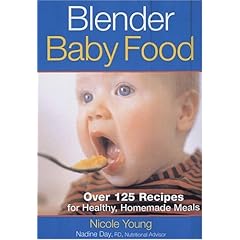
Blender Baby Food by Nicole Young. I got by with "Super Baby Food" with Josie, but I really wanted to branch out a bit and make some more interesting foods with Jasper. This book really did that for me. It focuses on the 6-12 month age range with sample menus and recipes for each age. Many of the recipes we still enjoy (like the Citrus Couscous, Veggie Paella, and Jambalaya. Even the purees are fun, like Rhubarb, Apples, and Berries, or Trout, Zucchini, and Potatoes. I think it really broadened Jasper's tastes.

Finally, since I've somehow been blessed with kids who will eat anything, I keep running out of ideas. Seriously, I'd love to fall back on chicken nuggets and mac and cheese sometimes, but they want to eat! So I picked up Toddler Café: Fast, Healthy, and Fun Ways to Feed Even the Pickiest Eater at the library and I have to order a copy for myself. The 'picky eater' part sort of threw me, but it's full of great ideas for fun meals that are really healthful and full of fresh good food that isn't too far out there (like random curries and the like which my kids will eat, but I wanted simple food). It's from Chronicle Books (where all good books seem to be born) and they have some recipe excerpts on their website if you'd like to check them out. If you want to have one book to inspire you to feed your little kids well, this is really it.
diy baby/kid food: review SocialTwist Tell-a-Friend