Showing posts with label babies. Show all posts

more info on choosing a safe sunscreen/sunblock for children: UVA, UVB, what does it mean?


After my post on sunscreen the other day, I kept feeling like there had to be more to know so I kept poking around. Here's what I found:
  • Katja at Skimbaco has a very helpful post up expressing her concerns about the ingredients in many sunscreens, a review of the various formulations, and some specifics on good sunscreens to choose...including some that are very reasonably priced. The Baby Blanket brand sounds almost too good to be true--pretty good choice of ingredients, waterproof, SPF 50, and at $12/9 oz it seems like a bargain. Baby Blanket also makes a number of other products such as a 'scalp spray' for bald babies and a lotion spray for legs and backs. I had kind of settled on the Aveeno Baby lotion for the big kids and California Baby brand for our infant, but I think that this would be a better all around choice. Anyway...
  • The Skin Deep Cosmetics Database that I mentioned last time has a full listing of all the active ingredients in sunscreens, what their efficacy at blocking UVA and UVB rays is, what the potential harm in them is, and how bad it is for you (rated 1-10, very simple to follow). I won't even go over a few of the common ones since the information they provide is so complete and succinct.
  • Safe Mama has created another handy cheat sheet distilling all this information into a handy list of good and bad choices in sunscreens. Print it out, shop with it, and feel like a good parent. They have a whole selection of other info sheets covering bath products, skin care, and sippy cups if you're interested.
Also, following the terminology can be a little tough, so here are a few terms to know:
  • SPF: Sun Protection Factor. A measure of how effectively the sunscreen blocks the sun's UVB rays. It's calculated by comparing the amount of time needed to produce a sunburn on protected skin to the amount of time needed to cause a sunburn on unprotected skin.
  • UVB: Short-wave part of the spectrum of sunlight; more potent than UVA in causing sunburn, thought to be the main cause of basal and squamous cell skin cancers as well as a contributor to melanomas.
  • UVA: Long-wave solar rays. Less likely than UVB to cause sunburn, but penetrates the skin more deeply; considered chief cause of wrinkling and "photoaging." Apparently increases UVB's cancer-causing effects, but may be main culprit of melanomas. Not blocked by all sunscreens, so check the label!!
  • Sunscreen: Chemically absorbs UV rays.
  • Sunblock: Physically deflects UV rays.
  • "Broad-spectrum Protection": This indicates that a product protects against UVA and UVB, but doesn't guarantee coverage against all UVA wavelengths. Sunscreens containing avobenzone, zinc oxide, or titanium dioxide should be effective against entire UVA spectrum.
more info on choosing a safe sunscreen/sunblock for children: UVA, UVB, what does it mean? SocialTwist Tell-a-Friend

choosing a sunscreen that's safe and effective

Last summer I stocked up on tons of sunscreen. Living in Colorado we're at about a mile's elevation (that much closer to the sun!) and it can be brutal, especially for someone as fair-skinned as our oldest daughter. With everything else we were concerned about I was pretty worried that we were coating our children with something several times a day and felt that since I was bothering to buy organic produce I should really be similarly concerned about the safety of our sunblock.
Ideally, a sunscreen would be block both UVA and UVB rays (UVA causes invisible damage while UVB causes the red burn that you see), contain ingredients that don't break down in the sun (since once the active ingredients break down you're at risk for sunburn), and all ingredients would be proven safe for both adults and children. After looking a bit, I found no sunscreen that met all of these criteria. Big surprise. In the end, I had to prioritize, so I made a list of what was really important to me.

Here were my requirements:
  • easy to apply, preferably a lotion/cream for faces and a spray for the rest of their body so that I could reapply often, even if the kids were busy
  • SPF 30 or better
  • something non-stinging since it inevitably finds its way into their eyes
  • a water-resistant formulation since we spend a lot of time in the sprinkler
  • something that didn't contain really concerning ingredients
  • reasonably priced, since we need to buy it by the gallon
Sounds easy, eh? It actually wasn't too bad once I found the right resources. The Cosmetics Database provides a list of children's sunblocks with separate ratings for effectiveness at preventing sunburn as well as safety of ingredients. Since I just didn't have the energy to remember that MEXORYL SX degrades quickly or that OCTINOXATE may have estrogenic effects...let alone to consider how various combinations may be better or worse, I appreciated their simple color-coded guide to product safety. Referring to their list, many of their recommended choices met my requirements but were still really expensive. Since I need to use about 1/2 oz per child per application to get the recommended whitish coating (and I'd bet on at least 2 applications per child on an average day) I was looking at about 20 oz per week through the summer. The Cosmetics Database's top choice was Badger, but at $14/2.9 oz (at REI) I didn't even want to do the math. We'd go through that in a day.

In the end, I simply couldn't afford to spend a few hundred bucks on sunblock for the summer, so chose one lotion for the big kids (it got a green rating overall in spite of having some questionable ingredients) and and a more expensive one for our infant since she (a) doesn't use much and (b) is tiny and seems particularly susceptible. I skipped the spray since there was no reasonably priced choice that was also sufficiently safe. Hopefully that will change by next summer.

Finally, while I was looking through their database I checked into the safety of the sunblocks I already had on the shelf. I was surprised to find that the Neutrogena I had bought for myself didn't stand up to the SPF rating on the bottle--explaining why I got a light sunburn (and extra freckles!) on my face a couple of times last summer. If nothing else, you might want to check into the actual efficacy of the sunblocks that you already own to avoid a surprise sunburn.


*Also, don't forget to rate this post using the stars at the bottom of the post...I'm basically interested in knowing whether this is content you liked or didn't like. Thank you so much!
choosing a sunscreen that's safe and effective SocialTwist Tell-a-Friend

Surprising sources of BPA, phthalates, and PVC in your house (it's there!)

After a bit of looking over the weekend we realized that although the liquid-holding body of our sippy cups were phthalate and Bisphenol-A (BPA)-free, the lids weren't. Further, our daughter's pacifiers have BPA in the shield that holds the nipple and that...basically everything in our house has something bad in it. After throwing out the cups and switching pacifiers (we're going with the Evenflo Mimi since the nipple shape seems a lot like our standard MAMs), we're still left wondering what else is lurking. Here are some of the surprising sources we found in our trip around the internet:
  • Food cans are lined with an epoxy resin coating that almost always contains BPA. This is particularly concerning with acidic foods such as tomatoes, and for liquid baby formula (since BPA has been found to leach out into fatty substances in higher concentrations). Eden Foods is the only company that I know of (or could find) that has removed this from their packaging (for beans, at least, not for tomatoes).
  • Rubbermaid has an area on their site devoted to helping you determine whether Rubbermaid products you already own are a source of BPA. For other kitchen items, you can check out the cheat sheet for safe(r) plastic containers, and Z Recommends has a super-comprehensive listing of what baby feeding products to avoid.
  • Nearly all baby mattresses are wrapped in PVC. PVC is generally considered to be one of the most toxic and environmentally damaging plastics in use and off-gasses nasty stuff into the air (it's what makes new cars smell like, well, like new cars). Additionally, they're filled with urethane foam, which releases nasties like benzene, and coated with a fire retardant containing things like antimony and arsenic. You can get around this by purchasing a cotton, wool, or natural latex mattress.
  • Tooth-colored composite fillings often contain BPA--some are composed of up to 90% BPA.
  • Some plastic wraps contain phthalates. These are mainly commercial grade wraps; Saran Wrap, Glad Cling Wrap, and Diamant Food Wrap (Diamant is made of cornstarch and compostable) definitely do not. Also, some plastic cutting boards contain BPA or phthalates.
  • Two of the baby teethers that we owned contained phthalates. We also have a number of rubber duckies (which our oldest daughter used to carry in her mouth as she crawled around the house); some rubber ducks have been found to contain very high levels of DEHA, a particularly nasty phthalate. Safe Mama has a guide to figuring out whether the teethers and pacifiers you're offering may contain BPA or phthalates and for choosing safe(r) options.
  • Many personal care products contain phthalates (patently bad) and parabens (jury's still out on actual badness), including baby washes, lotions, and cosmetics. Safe Mama offers a cheat sheet for this too. To generally stay away from phthalates altogether, here is a guide to other products to avoid.
  • Sunscreen often contains parabens and phthalates, as well as formaldehyde, and some potentially estrogenic compounds such as benzophenone, homosalate, and octyl-methoxycinnamate/octinoxate. Considering the relative amount of surface area on a baby, you can expect that their exposure to these chemicals by weight will be much higher. Cosmetics Database has a super-comprehensive list of sunscreens to buy, what to avoid, and best of all (for us living up in the mountains, that much closer to the sun) a listing of how accurate the SPF rating on the bottle is.
Now that I've totally freaked you out, I personally think that this should all be taken with a grain of salt. I cook with lots of canned foods (especially tomatoes), all of my children have slept on PVC-wrapped, flame-retardant, urethane foam mattresses, and my mouth is full of pretty white fillings. There's not much I can do about some of this (let alone our general exposure to environmental toxins), but I think that it would be easy to make some simple changes that would work with our lifestyle.

More from the collective:
Surprising sources of BPA, phthalates, and PVC in your house (it's there!) SocialTwist Tell-a-Friend

The basics: What are PVC, BPA, phthalates, and dioxins?

We keep reading about how bad the stuff in our house is, but I'm still confused about what it all is and why I should be worried about it. So here is the Cliff's Notes version:
  • Bisphenol-A (BPA) is a component in plastics (mainly polycarbonate [recycling #7], which is clear and shatter-resistant) and the epoxy linings of food cans. There are two camps on the safety of BPA. The American Plastics Council maintains that the potential human exposure to BPA is extremely low and poses no known risk to human health. On the other side are groups maintaining that the APC is basing their recommendation on outdated research and that over 100 newer studies are showing adverse effects of BPA exposure in animal models, suggesting that it does have a biological effect. Structurally BPA is very similar to naturally occurring estrogen and there is evidence that it disrupts endocrine function in the body and it has been linked to low sperm count, hyperactivity, early puberty, obesity, small testes size, and enlarged prostates.
  • Polyvinyl Chloride (PVC; recycling #3) is used in a great many products. From construction materials such as sprinkler pipe and vinyl siding to credit cards and music records nearly all of us come into contact with it on a daily basis. It can be made softer with the addition of phthalates, making it useful in the manufacture of clothing, vinyl toys, and flexible hoses such as those used in medical applications.
  • Phthalates are used as plastic softeners, oily substances in perfumes, additives to hairsprays, lubricants, cosmetics, and wood finishers. One of these, DEHP (diethylhexyl phthalate), has been banned in the European Union out of concern for children's safety. Health concerns surrounding PVC are related to both contact exposure (e.g. children mouthing toys) and offgassing (e.g. compounds released into the air--see 'new car smell'). High doses are known to be toxic, but the current research is focused on the effect of chronic, low-dose exposure, and exposure to children and fetuses during critical periods of development (e.g. DEHP was found to produce dramatic changes in male sexual development with low-dose exposure in utero). Additionally, it has been related to exacerbating allergic reactions to an allergen. (Here is a fairly non-neutral source of additional information including a list of products to avoid if you're trying to stay away from phthalates.)
  • Parabens widely used as preservatives in the cosmetic and pharmaceutical industries, as well as in food products (here is a not-too-biased source of information about these products). Long-term studies have generally found parabens to be safe. However, other studies have found the presence of parabens in cancerous breast tumors, leading to concern that parabens in underarm deodorants may be related to the development of cancers. Further, parabens have been found to have weak estrogenic activity in the body. This category seems to still have a big question mark.
  • Dioxins are produced as a biproduct of PVC manufacture, and are also found in a variety of household goods such as most brands of baby diapers. They are considered to be a global health threat because they persist in the environment for an extended period and appear to be very toxic. At even very low levels, near those to which the general population is exposed, dioxins have been linked to immune system suppression, reproductive disorders, a variety of cancers, and endometriosis.
I hope you found this as helpful as I did. My head was really starting to spin trying to figure out which was which, and how bad any of this really is.
The basics: What are PVC, BPA, phthalates, and dioxins? SocialTwist Tell-a-Friend

diy baby/kid food: review

So you now know that Adelaide (the youngest member of the collective) is totally into pickles. I don't know that I would've let Josie love pickles as one of her first handful of foods (thanks to my maternally overprotective instinct), but daddio and I have encouraged our kids try a wide variety of strange and unexpected foods and have made nearly all of their 'baby food' (that is, the purees, snacks, and chopped up stuff that they eat for the first six months or so). So far it's really worked! We have a couple of kids who will eat just about anything (Josie avoids spicy things, Jasper's not really into meat, and we all dislike avocados, but everything else is fair game). Thank goodness, since I was such a picky eater. I don't quite know how my mother put up with it!
Fundamental to our strategy to make our children the type who will eat anything was the 'making our own baby food' part, plus introducing them to bits of table food as early as possible (which is why Adelaide was enjoying bits of watermelon and sucking on a celery stalk yesterday). I would have to say that it has been a pretty easy addition to what we already do, and that it has saved us tons of cash in the process. You don't need much to start the process, and even if you're only making some of your kid's food you'll still be saving money, producing less waste, and feeding your baby foods that taste like real food....setting them up to love real food later!

So what do you need to get started?

1: A blender, food mill, baby food grinder, or food processor. When I'm churning out batches of baby food to freeze I prefer the blender, but as they get a bit older and I'm processing a bit of what we're having for dinner or grinding batches of chunky food like chicken pot pie I like the mini food processor or baby food grinder. Nothing special here, and I'll bet you've already got one of these in your kitchen.

2: Ice cube trays and zip-top freezer bags. Once you blenderize the food with a bit of water or breastmilk, just pour it into ice cube trays and freeze it until solid, then turn it out into freezer bags for long-term storage. I have a stash of trays that I picked up at the thrift store for about $1 for six.

3: Food. You can use fresh or frozen fruits and vegetables, regular full-fat yogurt, jarred nut butters (e.g. cashew and almond), or even what you've made for dinner. We don't really limit seasonings, but I generally don't add salt or butter, etc, to simple purees.

Seriously, that's it. I can buy a big bag of organic frozen peas, cook, puree, and freeze about 12 servings in ten minutes (and empty the dishwasher while the peas cook). I know what's in the food and that it tastes fresh and like sweet garden peas rather than pale, mushy canned peas. All told, it costs about ten to fifteen cents per serving with no jar or container to throw out.

This is really a simple guide to get you started. To really get the job done I've relied on two books to supply guidelines about what foods should be fed at what ages (e.g. no yogurt until 9 months, no corn until a year, etc) and how to process certain foods (you have to cook some foods but not others, must be careful peeling mangos, etc), and recipes to combine foods and make my own cereals. I've looked at a lot of choices and own several, but these are my go-to guides:

Super Baby Food by Ruth Yaron. This book has a sort of gonzo "I made it in my basement" quality about it, and the author comes across as a little nutty, but it is an absolute goldmine of nutritional information about any fruit, vegetable, grain, or vegetarian option you can think of. She's got recipes for various cereals (like her super porridge), discusses the importance of adding supplements like flax oil to boost omega-3s, even recipes for playdoh and other fun toddler stuff. This book is a great choice for vegetarians, too, since I believe that she has raised her children in a meat-free environment, but she discusses the preparation of meat foods as well. The first half of the book is devoted mostly to how to start feeding your baby foods, where to start, how to ramp it up, sample menus, etc. If you only buy one book, buy this one.

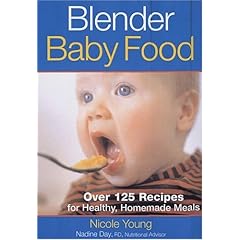
Blender Baby Food by Nicole Young. I got by with "Super Baby Food" with Josie, but I really wanted to branch out a bit and make some more interesting foods with Jasper. This book really did that for me. It focuses on the 6-12 month age range with sample menus and recipes for each age. Many of the recipes we still enjoy (like the Citrus Couscous, Veggie Paella, and Jambalaya. Even the purees are fun, like Rhubarb, Apples, and Berries, or Trout, Zucchini, and Potatoes. I think it really broadened Jasper's tastes.

Finally, since I've somehow been blessed with kids who will eat anything, I keep running out of ideas. Seriously, I'd love to fall back on chicken nuggets and mac and cheese sometimes, but they want to eat! So I picked up Toddler Café: Fast, Healthy, and Fun Ways to Feed Even the Pickiest Eater at the library and I have to order a copy for myself. The 'picky eater' part sort of threw me, but it's full of great ideas for fun meals that are really healthful and full of fresh good food that isn't too far out there (like random curries and the like which my kids will eat, but I wanted simple food). It's from Chronicle Books (where all good books seem to be born) and they have some recipe excerpts on their website if you'd like to check them out. If you want to have one book to inspire you to feed your little kids well, this is really it.
diy baby/kid food: review SocialTwist Tell-a-Friend

how to keep your kid safe from lead poisoning: link

There's an interesting post over at Safe Mama about protecting children from lead poisoning. We live in a neighborhood with a lot of older homes and I know of at least a couple of young kids who were found to have high levels of lead in their bodies. Since it's not typically tested for, it's hard to know how many other cases go undetected until the effects of chronic lead exposure are severe and irreversible!
Safe Mama is also a great resource for information on BPA/bisphenol-a/polycarbonate, safe beauty products, toys etc, if you're looking!
how to keep your kid safe from lead poisoning: link SocialTwist Tell-a-Friend

mmmmm....teething toys!

I got a great question from Susannah, mother of a little teether:
i do have question for you...whats your best recs for teething toys? is there a particular website or brand of toys i should look for?

Great question! If you haven't noticed, I love to give advice (as my close friends will attest to) and with a six month old myself, I hope I can give you some helpful insight. We have a pretty healthy selection of baby toys, and I've found over time that my kids have generally really liked toys with a bit of give, made out of things like wood, cloth, or rubber-y plastic (which I'm really wondering about now after my research about toys and plastics!). The few harder plastic toys (which I think may have been polycarbonate, a source of bisphenol-a) didn't seem to be that gummable to them, so I got rid of them anyhow. Our current favorites are the Sassy Earth Brights, particularly the dove and the cherry tree rattle. Adelaide seems to like the different textures, and particularly the crinkly-fabric parts, and I like both of these because they're easy for her to hold and find something to bite on. I've generally stayed away from the ones that are on a ring since they seem to be the hardest for a baby to get the part they want into their mouth while holding on to the ring since the pieces slide, but the Nuby Bug-a-Loop is an exception. I'm starting to worry since it's plastic, but the rubbery bugs have a nice bite and different textures. She also likes to chew on stuffed toys, and the Haba Little Dwarf has arms and a hat for good gumming, while having no chokable parts to pop off, and a nice little rattler sewn securely inside.
Haba makes a variety of rattles and wooden teethers available from Amazon and Oompa Toys. I haven't tried any of them, but they are so cute! Like the Bonita Clutching Toy up at the top!

The thing is that, realistically, your baby grows out of these by about 10-12 months, and they're always happy to rediscover the same toy so you probably only need 3-4 really good choices. Also, you want to be super-careful about giving your little one anything with loose parts that they might be able to pull off (obviously), or that they might poke themselves with (like a baby spoon, oops!). Also, my children seem to be magnetically attracted to my keys, but keys may have a high lead content and babies shouldn't be allowed to mouth them.

How about you? Do you have any ideas for Susannah about baby teethers? Places to look, things to watch for? Please share in the comments (right below the end of this post).
mmmmm....teething toys! SocialTwist Tell-a-Friend

No No Yes Yes: book


No No Yes Yes


Written and Illustrated by Leslie Patricelli


0-3 years, board book


Playing with bath toys in the potty = no no. Sitting on the potty = yes yes. Leslie Patricelli's newest book gives plenty of fun, visual examples of happy baby behavior. Each pair of pages shows the happy baby (boy? girl? does it matter?) engaging in a pair of complimentary, sometimes silly, behaviors. Cutting hair? NO! Cutting paper? YES! The last page spread gives a number of smaller illustrations of no nos and yes yeses. Patricelli's other books include Baby Happy Baby Sad, Big Little, Binky, Blankie, Quiet Loud, and Yummy Yucky.


We at the collective have loved Leslie Patricelli's books since Josie was a baby. "Yummy Yucky" was our first and caught us with her simple, colorful illustrations, sparse text, and general silliness. It provided a great jumping off point for clarifying what yummy and yucky were for baby Josie, for learning the sign language for each, and as she got older it was a simple book for her to 'read' to herself (or recite at least). When I spotted Patricelli's latest two releases I was so excited!

No No Yes Yes
captures the same qualities and introduces more truly helpful concepts like not pulling the cat's tail, holding hands while crossing the street, not ripping books up, etc. With Jasper (2.5 years) it was nice to move from page to page and ask "What's the no no on this page?" or "What's the big boy doing on this page" to really draw his attention to the ideas rather than just looking at the great illustrations. The topic and illustrations really suit our (how can I put this delicately?) eccentric parenting style and capture the kids illustrations.


Mommy: Another book I can wholeheartedly recommend.


Josie: It was so silly. It was so fun, I would say it's a five. Five stars. So good. Really for Jasper though. It was too easy for me.


Jasper: I think it is ... I want read it again. It be really good.
No No Yes Yes: book SocialTwist Tell-a-Friend